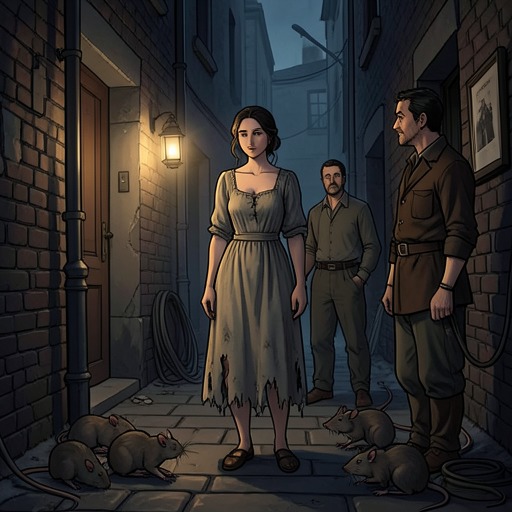
The Rat-Piper Contest in Bad Blintz
The Amazing Maurice and His Educated RodentsThe Rat-Piper Contest in Bad Blintz turns a public challenge into a test of what the piper’s authority is worth: spectacle, fear, or a genuine ability to lead. Keith wins the contest with a battered trombone, but his decisive move is not simply to take the pipe. He offers the piper a way to keep his standing and earn payment by helping the rats leave town, redirecting a contest built on rivalry toward cooperation.
A challenge in public
The contest begins when Keith openly calls the piper a fraud and a bully, claiming that he can summon more rats than the man who has been presenting himself as a rat piper. The challenge is pointed: the piper has not yet played a note, but his reputation already shapes the crowd’s expectations. People begin edging away, anticipating that he may lose his temper. Keith’s accusation therefore tests more than musical skill; it challenges the fear and performance on which the piper’s public status rests.
The piper accepts, treating the contest as an opportunity for another story to circulate about him. The crowd is not uniformly confident that Keith can win. Some support for giving the boy a chance emerges only hesitantly, and the piper himself dismisses Keith’s choice of instrument before the test begins. The public setting makes the outcome consequential: the piper’s claim to respect is being examined in front of the people whose belief and money sustain it.
The instruments and the test
Keith has never played a rat-piper’s instrument. Instead, he asks for a trombone, reasoning that he can learn as he goes along. A watchman brings one back; it is battered and grimy, and Keith wipes the mouthpiece, tests the keys, and produces a long note. His readiness to proceed despite his inexperience contrasts with the piper’s confidence in appearances. The piper expects the instrument to fail before Keith has begun.
Keith’s first performance is fast and jaunty, though the trombone squeaks and wheezes. Sardines emerges from a crack in a nearby wall, quietly keeping time, and dances across the cobbles before disappearing into a drain. The crowd applauds. This is a small but clear answer to the challenge: Keith has not summoned a host of rats, but his playing has drawn a real rat into the open and moved him to dance. The piper asks whether the rat wore a hat; Keith says he did not notice and invites the piper to take his turn, refusing to let the exchange become a mere argument about appearances.
The piper’s counter-performance depends on a clockwork rat, but the device fails when its spring gives out, sending its cogwheels flying and making the crowd laugh. The contrast exposes the difference between a living rat responding to music and a mechanical imitation meant to support the piper’s show. The piper’s reaction shifts: he regards Keith with grudging admiration and proposes a private conversation, but Keith insists that people be able to see them. Even after winning the musical contest, Keith remains alert to the possibility that the piper may try to control what happens next.
Winning the pipe without humiliating the piper
Keith asks whether the piper has ever met Maurice. When the piper says he does not think so, Keith takes the pipe and studies him before announcing that the piper is going to lead the rats out of town. Keith describes the job as the most impressive one the piper has undertaken, not as punishment for losing. The pipe changes hands, but the victory does not become a demand that the defeated man disappear or be publicly disgraced.
The piper explains the economics of his performance: elaborate clothes, bullying, and a high price are part of the show. He presents himself as more than an ordinary rat-catcher because people pay for what seems magical. Keith answers with a different bargain. They will work together, the rats will follow them for real, and the piper will receive the agreed fee—three hundred dollars, reduced by half because Keith is helping. The offer preserves the piper’s payment while changing what he is being paid to do. Instead of staging a trick, he can take part in an undertaking whose outcome depends on the rats actually following.
Keith’s proposal also gives the event a public meaning beyond who has the better instrument. He wants the departure to become a great story, but he does not treat storytelling as a substitute for what happens. The people will see the piper lead the rats, and the rats will leave town rather than simply be frightened into retreat. Keith’s arrangement makes room for the piper to participate in a new account of his own role, while refusing to pretend that his earlier display was genuine mastery.
From contest to negotiation
The contest’s practical consequences extend into the town’s attempt to resolve its rat problem. With the pipe in hand, Keith urges the mayor to talk with the rats and convene the town council, warning that driving them away with dogs or brooms would not make them stay away. Darktan then presents the rats’ position as an opportunity rather than a threat. The contest is therefore part of a larger shift: away from showmanship and repeated confrontation, toward a public arrangement that has to account for both human and rat interests.
That shift is not presented as an effortless happy ending. Dangerous Beans recognizes the appeal of cooperation but also rejects Spider’s proposal to rule together, seeing that an alliance founded on domination would not work. Later, the prospect of a bright future gives way to the harder need for a contract and a committee. Against that background, Keith’s decision to pay the piper and work with him is a small-scale version of the book’s broader practical principle: a settlement is more likely to hold when it gives the other party a reason to take part, rather than making victory depend on their humiliation. The contest begins as a wager over who can command the rats; it ends with Keith using the pipe to invite a former rival into a task that could benefit both sides.